
How many restrooms does a race need?
Course length and runner count both drive the count, and finish-area crowding usually needs more units than any single aid station. OSHA 1926.51(c) sets 1 toilet per 20 people as a working ratio, and that number scales fast once spectators show up alongside runners. A typical aid station gets 2 to 4 standard portable restrooms, while a finish festival for a few thousand people often needs a bank of 10 or more, plus at least one ADA accessible unit under ADA Standards 213.2, which requires 5 percent of clustered units be accessible with never fewer than one. Races through River Road, 2.4 miles north of central Eugene, or out toward Santa Clara, 4.4 miles north, still fall under the same planning math even though the crowd thins out along the route. If you are not sure where your event lands, the porta potty needs guide walks through headcount by hour. For a start/finish combined at one venue, event restroom rental planning differs from a point-to-point course, and we size each differently. Multi-day expos pair well with festival restroom rental service, and a wedding tied to a race weekend can pull from wedding restroom rental options too.
Where should race restrooms be placed?
Aid stations need restrooms set back from the running lane but within a short walk, never blocking the course or a medical tent. Ground has to be reasonably level and stable per ADA Standards 302.1, and any accessible unit needs a 60 inch turning circle in front per ADA Standards 304.3.1. Door openings on ADA units run wider than standard doors, which matters for wheelchair racers and handcyclists finishing near the crowd. If your race route touches Springfield, 9.2 miles east, or Coburg, 10.5 miles northeast, we coordinate placement across both jurisdictions so aid stations line up with road closures. Delivery trucks need roughly 60 feet of straight clearance to set units, so we scout tight downtown blocks in advance rather than guessing on race morning. Finish-line power for timing tents, PA systems, and food vendors often runs off a temporary power pole, and how to brace a temporary power pole matters here: guy wires or a braced base keep the pole upright against wind and the crowd pressing near barricades, and OSHA 1926.404(b)(1)(ii) covers the GFCI protection that pole should carry. Pair that with light tower rental for early starts or evening finishes, and temporary fence rental or crowd control barrier rental to keep foot traffic organized around the restroom bank.
What restroom options work best for race day?
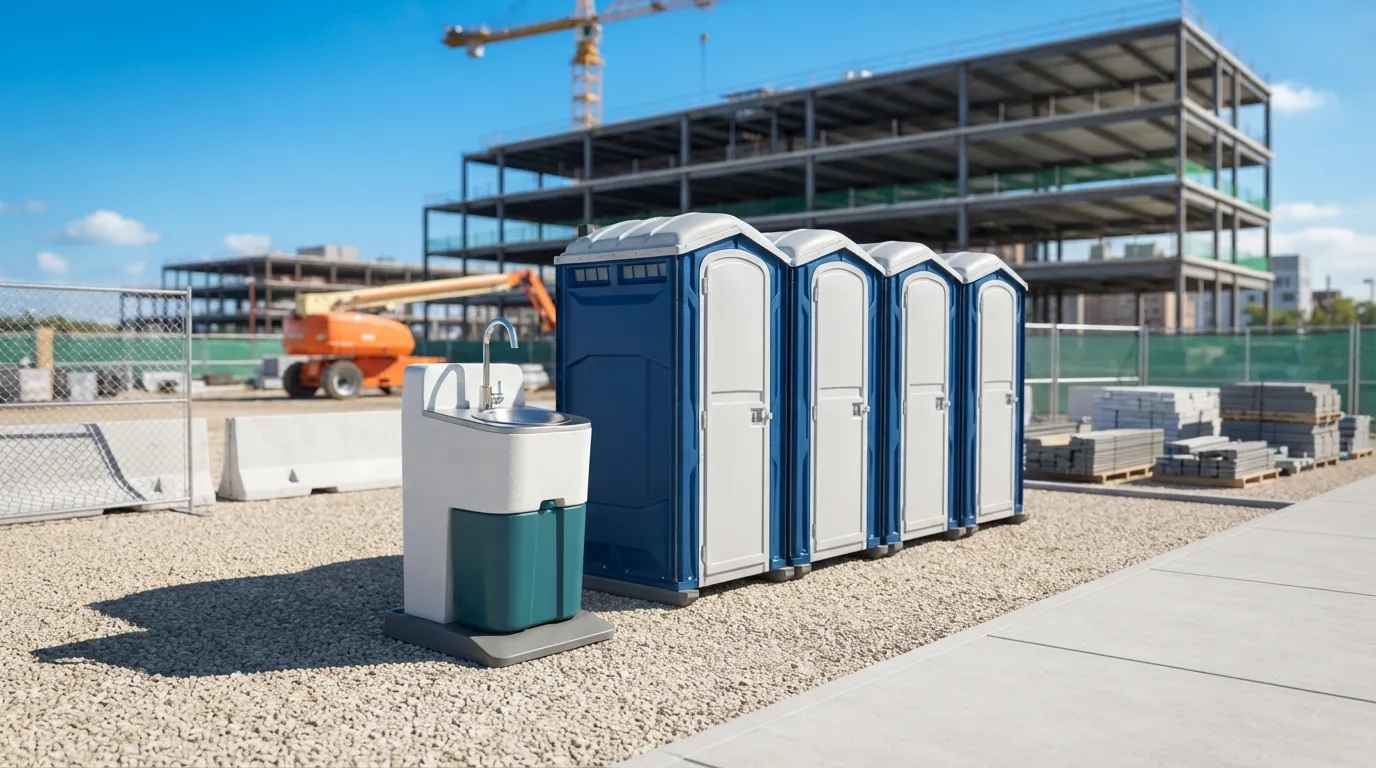
Budget and finish-line image both play into the choice. Standard units handle aid stations and mid-course stops fine, while a finish festival with sponsors and media benefits from something nicer. Here is what a typical race weekend runs:
| unit | duration | low | typical | high |
|---|---|---|---|---|
| standard | event | 200 | 400 | 800 |
| ada | weekend | 199 | 240 | 300 |
| trailer | event | 2499 | 3500 | 3899 |
A restroom trailer at the finish line gives sponsors and VIP runners a nicer stop, and a 2 stall restroom trailer or 4 stall restroom trailer covers most mid-size finish areas without the footprint of an 8-stall unit. Races expecting rain should check porta potty in winter notes on ground protection. For hand cleanup after aid-station gel packets and sports drink spills, a handwashing station rental or portable sink rental keeps 29 CFR 1910.141(d)(2) in mind, since that rule requires soap and towels or a hand-drying device, not sanitizer alone. Full permit and placement rules should be confirmed with the City of Eugene before race day, since right-of-way placement for a closed-street event is not something to guess on; our porta potty permit requirements page has a starting checklist, and the placement guide covers clearances and slope.
How far in advance should I book race restrooms?
Book as soon as your course map and headcount estimate are set, ideally 6 to 8 weeks out for a large race weekend. Smaller local runs can move faster. Delivery scheduling gets tighter close to race day, especially if your event overlaps another booking near Junction City, 13.4 miles north, or Creswell, 15.4 miles southeast.
Do we need ADA restrooms for a race?
Yes. ADA Standards 213.2 requires at least one accessible unit in any cluster, and more as the cluster grows. Races with adaptive athlete divisions should plan extra accessible units at both the start and finish, not just one for the whole event.
Can restrooms be placed along a closed race route?
Yes, with a delivery plan built around road closure timing. We stage units before the closure starts and pull them after reopening, coordinating drop points so trucks are not fighting runners or barricades.
What if our race adds a health and safety inspection?
Reference OSHA 1926.51(c) for toilet ratios and 1926.51(a)(1) for potable water access at aid stations. We can supply a service log showing cleaning intervals if your event requires documentation for a county or venue inspection.
Does Eugene Porta Pros handle multi-day expos before the race?
Yes. Expo weekends often need restrooms a day or two before race morning for packet pickup crowds. We treat that as its own delivery window, separate from race-day service, so units are already in place and serviced before runners arrive.
Next step
Get a delivery date
Tell us the address, the dates and the headcount. We size the order and confirm the route.